How Brew Increased Engineering Capacity at Stratocyte
With Brew embedded into Stratocyte’s engineering workflow, more of the team’s time reached development, the same engineering capacity could support more development work, and the cost per unit of development fell.
The results
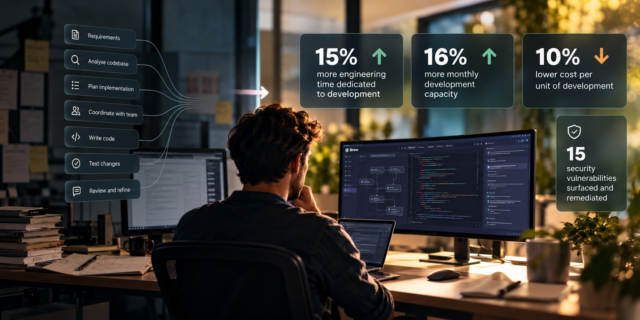
15%
more engineering time dedicated to development
16%
more monthly development capacity
10%
lower cost per unit of development
15
security vulnerabilities surfaced and remediated
Writing code has become easier.
Changing production software safely has not.
Engineers still need to understand requirements, work out what a change will affect, navigate an existing codebase, make implementation decisions, test those changes and make sure existing functionality continues to work.
A significant part of software delivery therefore happens before and around the code itself.
Our work with Stratocyte gave us an opportunity to measure what happens when more of that engineering workflow becomes AI-assisted.
Between June and September 2026, Brew moved from not being used on the engagement, through a transition period, to becoming part of the team’s regular engineering workflow.
The result was not simply faster code generation.
It was more engineering capacity reaching development.
The challenge: production engineering is more than writing code
Stratocyte is an existing production software platform.
The engineering team was not building from a blank repository. They were continuously evolving software that was already in use.
Every new requirement came with context.
- What does the business need?
- Where in the existing codebase should the change happen?
- Which parts of the system could be affected?
- What assumptions does the current implementation make?
- What needs to be tested before the change is released?
These are the parts of engineering that code generation alone does not solve.
Generating code is one part of the work.
Understanding what code should change — and changing it safely — is the larger problem.
That is what Brew is designed to help with.
What Brew changed in the engineering workflow
Brew works across the software-development process rather than treating AI as a standalone code generator.
Requirements can be turned into structured engineering work.
The existing codebase can be analysed to understand the impact of a proposed change before implementation begins.
Implementation plans give engineers a clearer path through the work.
Engineer-directed agents can assist with implementation.
Testing and regression workflows help validate changes before they are released.
The engineer remains responsible for the implementation and the final technical decisions.
What changes is the amount of surrounding work required to understand, plan and execute each change.
As Brew became part of Stratocyte’s engineering workflow, that shift started appearing in the operating data.
15% more engineering time dedicated to development
We used June as the pre-Brew baseline.
During June, the team recorded:
- 90.00 development hours
- 27.57 supporting BA hours
- 117.57 total engineering-team hours
For this analysis, engineering-team time is defined as development plus the supporting BA effort required to move engineering work forward.
Before Brew:
76.6% of engineering-team time went directly into development
July was the transition month.
By August and September, Brew had become part of the regular delivery workflow.
| August | September | Full-Brew period | |
|---|---|---|---|
| Development hours | 93.00 | 96.67 | 189.67 |
| Supporting BA hours | 11.30 | 14.42 | 25.72 |
| Engineering-team hours | 104.30 | 111.09 | 215.39 |
| Development share | 89.2% | 87.0% | 88.1% |
Across the full-Brew period:
88.1% of engineering-team time went directly into development
Compared with the June baseline of 76.6%, that represents an 11.5 percentage-point increase.
In relative terms:
15% more engineering time was dedicated to development
The shift also reduced the amount of supporting BA effort required.
Before Brew, supporting BA work accounted for 27.57 hours per month.
Across August and September, that fell to an average of 12.86 hours per month.
That is approximately:
53% less supporting BA effort
The important result was not simply fewer supporting hours.
It was that more of the same engineering organisation could focus directly on development.
16% more monthly development capacity
The change in how engineering-team time was allocated also increased the amount of development the team could support from the same overall capacity.
Before Brew, 76.6% of engineering-team capacity reached development.
In August, the first full-Brew month, that increased to 89.2%.
If we apply that improved allocation to the same engineering-team capacity as the June baseline, the difference is significant.
At the June allocation:
117.57 engineering-team hours × 76.6% = approximately 90 development hours
At the full-Brew August allocation:
117.57 engineering-team hours × 89.2% = approximately 105 development hours
That represents:
16% more monthly development capacity from the same engineering-team effort
This is a capacity measure rather than a claim that the team worked 16% more hours.
The underlying team capacity remains constant.
What changes is how much of that capacity can reach development.
Instead of approximately 90 development hours, the same level of engineering-team effort could support approximately 105 development hours at the improved allocation observed with Brew.
That is the leverage we care about.
Not increasing the number of hours worked.
Increasing what the existing engineering capacity can accomplish.
10% lower cost per unit of development
We also looked at the financial efficiency of the engagement.
Rather than comparing total monthly invoices, we normalised cost against billed development capacity.
This lets us compare delivery economics without exposing commercially sensitive client pricing.
Using June as the pre-Brew baseline and August–September as the full-Brew period:
Cost per 100 billed development hours fell by approximately 10%
The development rate itself did not need to fall for the economics to improve.
The change came from the composition of the work.
More of the engagement’s effort was reaching development instead of being consumed by the surrounding work needed to understand, coordinate and prepare engineering tasks.
That meant more development capacity could be delivered for each unit of consulting cost.
Brew surfaced 15 security vulnerabilities
Efficiency was not the only outcome we measured.
During the engagement, Brew surfaced:
15 security vulnerabilities
The engineering team subsequently invested:
30 engineering hours in remediation
We keep this work separate from ordinary bug fixing.
Those 30 hours are already part of the development hours recorded during the engagement. They are not additional hours added to the totals.
That distinction matters.
The goal of increasing engineering capacity is not simply to ship more features.
Better engineering also means having the visibility and capacity to identify risk and improve the underlying system.
In Stratocyte’s case, some of that capacity was deliberately invested in security remediation.
The four-month progression
The shift is easier to see across the full period.
| Metric | June | July | August | September |
|---|---|---|---|---|
| Brew adoption | None | Transition | Full | Full |
| Development hours | 90.00 | 113.42 | 93.00 | 96.67 |
| Supporting BA hours | 27.57 | 21.03 | 11.30 | 14.42 |
| Engineering-team hours | 117.57 | 134.45 | 104.30 | 111.09 |
| Development share | 76.6% | 84.4% | 89.2% | 87.0% |
July is treated as a transition period rather than being included on either side of the before-and-after comparison.
But the progression is useful:
76.6% → 84.4% → 89.2% → 87.0%
More engineering capacity began reaching development as Brew entered the workflow, and the improvement remained once Brew was fully embedded.
The result was leverage, not simply faster code
It is easy to measure AI-assisted engineering by asking one question:
How much faster can AI generate code?
We think that misses most of the opportunity.
Production engineers do not spend all of their time typing code.
They spend time understanding requirements.
Finding the right part of an existing system.
Working out what a proposed change affects.
Translating business intent into implementation decisions.
Recovering context when work changes hands.
Testing changes against existing behaviour.
A useful AI engineering system has to help with those parts of delivery as well.
For Stratocyte, the measurable improvement was not simply faster code generation.
It was a change in how the engineering team’s available capacity was used.
15% more engineering time dedicated to development
76.6% → 88.1% of engineering-team time across the full-Brew period.
16% more monthly development capacity
Approximately 90 → 105 development hours from the same monthly engineering-team capacity, based on the improved development allocation observed in the first full-Brew month.
10% lower cost per unit of development
Measured against billed development capacity.
And alongside those efficiency improvements:
15 security vulnerabilities surfaced and remediated
30 engineering hours invested in remediation.
That is the kind of leverage we are building Brew to create.
Not AI replacing engineers.
Experienced engineers spending more of their time engineering.
Methodology
This case study is based on operational timesheets and financial records from the Stratocyte engagement between June and September 2026.
June 2026 is used as the pre-Brew baseline.
July 2026 is treated as the transition period as Brew entered the engineering workflow.
August and September 2026 represent the full-Brew period.
For the operational analysis, engineering-team hours are defined as development hours plus supporting BA hours. QA activity is excluded from this calculation.
During July, 7.17 hours originally recorded under BA were reclassified as development because the work involved direct software implementation using Brew.
The 15% increase in engineering time dedicated to development compares the June development share of 76.6% with the combined August–September development share of 88.1%.
The 16% development-capacity figure is an extrapolated capacity measure, not a claim that recorded development hours increased by 16%. It holds the June engineering-team capacity constant and applies the 89.2% development allocation observed in August, the first full-Brew month. Under that model, approximately 90 development hours become approximately 105 development hours from the same engineering-team capacity.
Financial efficiency is calculated using invoice data and billed development hours, then normalised to protect commercially sensitive client pricing information. Absolute client billing figures are not disclosed.
Security-remediation hours are included within development hours and are therefore not counted again when calculating total engineering capacity.
This is an observational analysis of a real client engagement rather than a controlled experiment. The figures describe how delivery changed as Brew became embedded into the workflow and should not be interpreted as attributing every observed change solely to Brew.
Better engineering should be measurable
We believe the value of AI in software engineering should show up somewhere more meaningful than the number of tokens generated or lines of code produced.
It should show up in how engineering teams spend their time.
In how much of their capacity reaches development.
In the economics of delivering software.
And in their ability to understand, change and protect an existing production system.
For Stratocyte, that meant:
15% more engineering time dedicated to development.
16% more monthly development capacity.
10% lower cost per unit of development.
15 security vulnerabilities surfaced and remediated.
That is the standard we want Brew to be measured against.
Build software with more of your engineering capacity going into engineering
Brew Studio combines experienced technical leadership with an AI-native engineering platform built for real production software.
Talk to us about what you’re building.
